Curb notes
Outdoor bar stools with backs, and what a back costs you at the rail
Seven o'clock on the rail. The sun drops behind the tower across the street, the second round arrives, and the guests on backless stools start shifting their weight. The ones with a back to lean on order a third.
Outdoor bar stools with backs are a choice about the whole rail, though, and the seat is only part of it. A back adds width, changes how the stool sheds rain, and decides whether it stacks at midnight. Pick the back style, then check it against the rail length and the breakdown before you fill the cart.

Open diagram at full size (new tab) ↗
Read the diagram in text
Three outdoor bar stools drawn side by side on one floor line: a backless stool, a stool with a back, and a stool with a back and arms, each labeled with its width.
- RAIL NOTES
- Backless: 14 1/2 inches wide.
- With a back: Resin, 21 inches wide.
- Back and arms: Resin, 22 1/4 inches.
- Every step up in back and arms adds width at the rail. Count the stools after you pick the style.
Three backs, one seat height
Our resin outdoor stools come in three back styles on the same frame size, which makes the comparison clean.
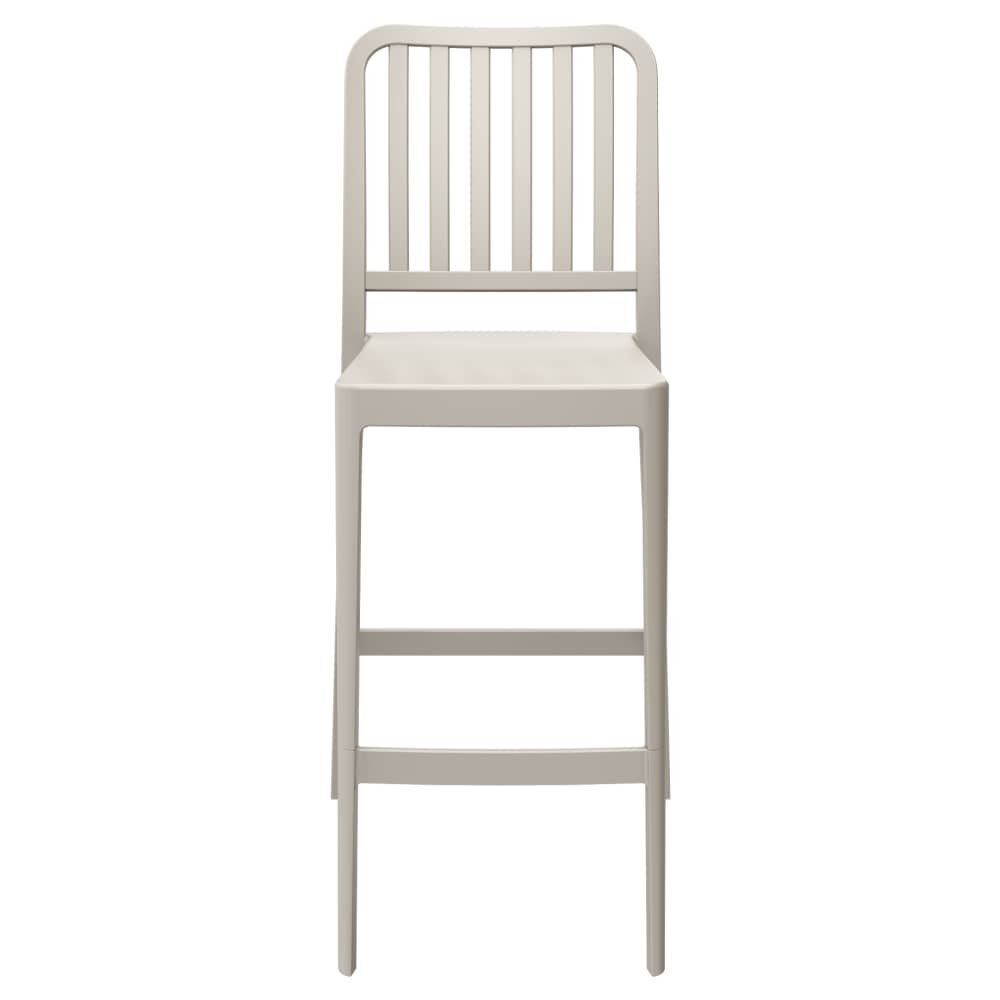
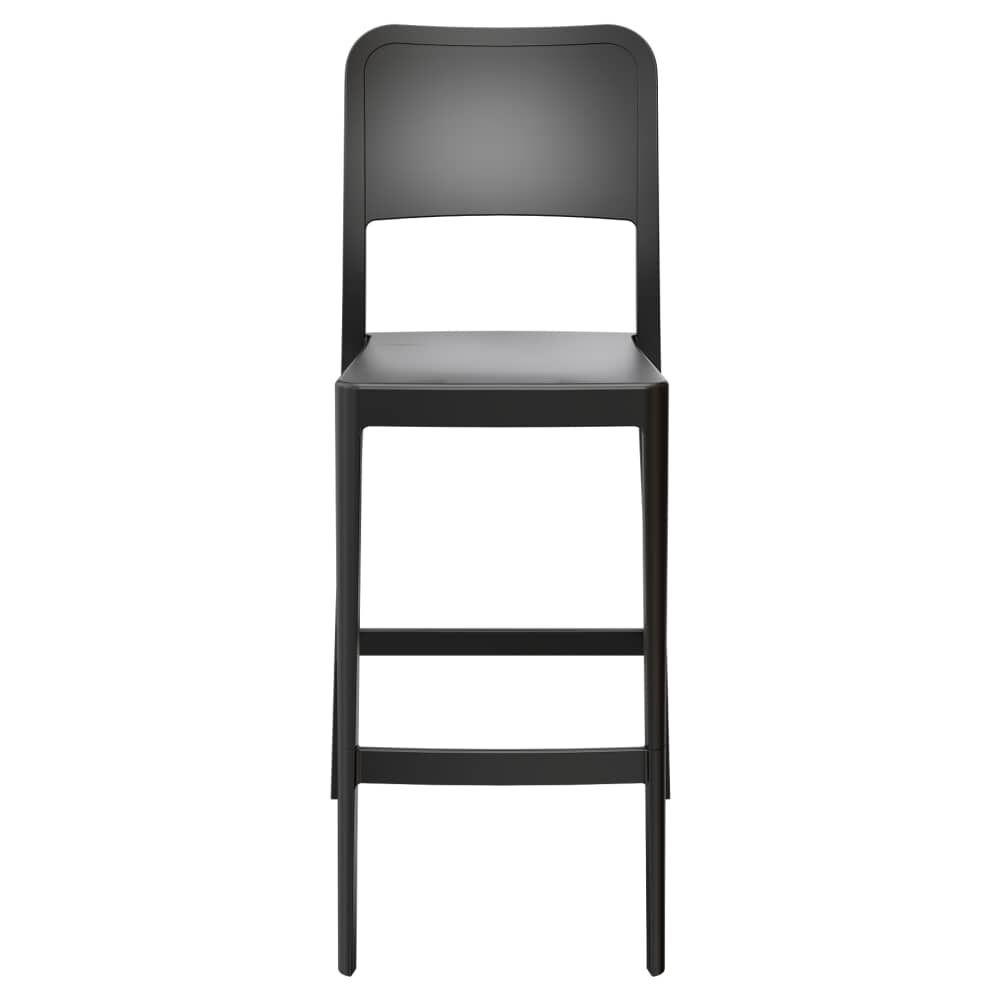
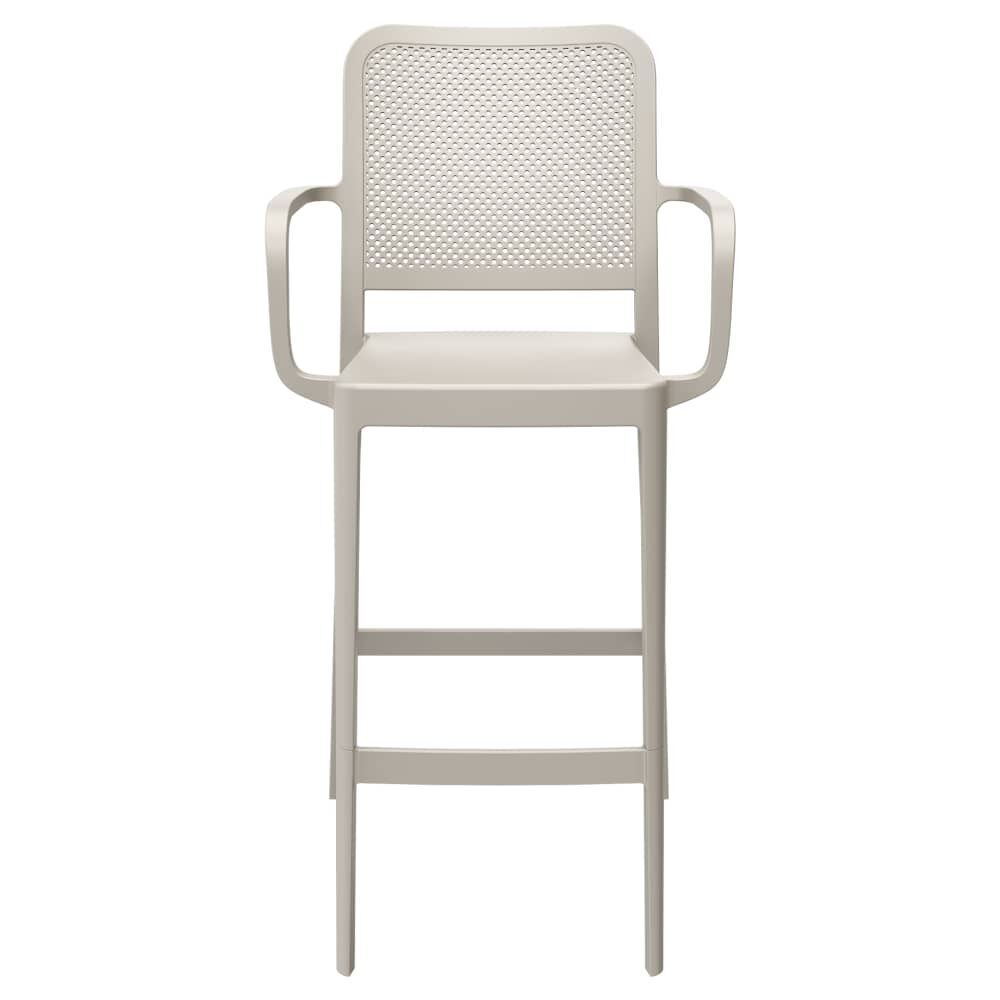
The slat-back resin bar stool has an open back of slats. The solid-back resin bar stool has one closed panel. The perforated version has a back punched with holes. All three are 21 inches wide, 23 1/4 inches deep and 45 3/4 inches tall, weigh 12 pounds, carry a 500-pound weight capacity and are listed as stackable. Where a seat height is given, it is 29 3/4 inches, right for a bar rail at 40 to 42 inches.
So the back is the only real variable. That is useful. It lets you choose on weather and looks, not on a spec sheet.
Beyond resin, the range adds a steel ladder-back stool, 16 1/2 inches across, with a 29 1/4-inch seat, a cross-back resin stool at 17 2/3 inches wide, and a metal stool with a vertical slat back in synthetic teak. Read that last one closely: its page marks it for use in a covered patio only. Under a roof, fine. On an open sidewalk, choose something else.
Browse the full set on the outdoor bar stools page, or narrow it to resin patio furniture and metal patio furniture.
Rain on a slat, rain on a panel
A shower passes at five. Service starts at six.
Slats and perforations let water fall straight through the back. A quick wipe of the seat and the stool is ready. A solid panel takes the spray on its face, so a towel has to cover the panel and then the seat. Multiply that by sixteen stools and the difference shows up in your setup time, not in any brochure.
Solid backs earn their place elsewhere. A closed panel reads as a clean block of color from the street, takes a wipe-down easily, and gives a sign-painter's tidy line along a long rail. On a covered terrace where rain rarely reaches the seats, it is the neatest look of the three.
Open backs suit the open roof and the bare sidewalk. Wind passes through them too, which matters when a gust catches a stool that a guest left pulled out from the rail.
Arms take rail space
Arms are where the rail math gets tight. Each of the three resin styles also comes with arms, and the arm version grows from 21 to 22 1/4 inches wide. The perforated resin bar stool with arms weighs 13 pounds, still stacks, and keeps the 29 3/4-inch seat.
An inch and a quarter sounds like nothing. On a long rail it adds up.
Worked example: a 20-foot rail is 240 inches. Bar stools want 24 to 30 inches center to center.
- Armless resin stools at 24-inch centers: 240 divided by 24 is 10 stools, with 3 inches of air between frames.
- The arm version at 24-inch centers leaves only 1 3/4 inches between arms. Too tight; guests bump elbows and the stools scrape.
- Move the arm version to 26-inch centers: 240 divided by 26 is 9 stools, with 3 3/4 inches between arms.
One stool lost for arms on every seat. Is that worth it? On a rooftop rail with a view, where guests settle in for the evening, maybe yes. On a sidewalk rail that turns over fast, keep the armless version and the extra seat.
A middle path works well: arms on the two end stools, where guests lean out and no neighbor gets crowded, armless in between. The center spacing stays at 24 inches for the inside run.
The metal mesh bar stool with arms is 22 inches wide and weighs 19 pounds. It is not listed as stackable, which brings us to midnight.
Stacking with a back on
Backs make stacking a question worth asking before the order goes in. A stool with a tall back has to nest over the one below it, and only the product page can tell you whether that stool does. The three resin back styles and their arm versions are all listed as stackable. So is the steel ladder-back. The mesh stool with arms is not, so plan floor space indoors for every one of them, standing on its own feet.
For a crew breaking down a rail every night, that line on the page matters more than the back style. Our guide to stackable outdoor bar stools works through the nightly carry.
If the stools stay out, chain them in pairs to the rail and cover them. Rinse the street dust off the backs every few days, slats included, because grit settles in the gaps.
When a backless stool is the right call
Not every rail needs backs. A narrow sidewalk counter against a window may only have room for a stool that slides fully under the ledge. The backless faux rattan bar stool is 14 1/2 inches square and 30 inches tall, with an aluminum frame at 8 pounds. It tucks away, carries easily, and keeps the walkway clear when guests leave.
Backless stools also suit quick drinks before a show or a short wait for a table. Backs belong where the guest stays.
If your ledge sits at counter height rather than bar height, start with our notes on outdoor counter stools before choosing any back at all. For woven looks, the wicker bar stools guide covers frames under the weave.
Chalk the rail before you order
Take chalk to the rail and mark a stroke every 24 inches, then every 26. Stand back from the street side and look at both. Count the marks for each spacing, and decide arms or no arms right there, with the actual run in front of you.
Then open an outdoor plan for that rail. Save the back style you picked in armless and arm versions, and set the quantities from your chalk count: for the 20-foot rail, say, two arm stools for the ends and eight armless between them on 24-inch centers. Write the spacing in the notes so whoever sets up the rail tomorrow knows where each stool goes.